
National Rollout of Long-term Care Insurance by End-2028: Only Two Years Left for Rehabilitation Institutions

01
National Long-Term Care Insurance: Three Key Points for Rehabilitation Equipment Entering the Payment Scope
▍There is room for "functional training" in the service catalogue
The National Healthcare Security Administration has formulated a nationally unified long-term care service catalogue, which includes 36 services urgently needed by severely disabled persons within the payment scope: 20 life care services (assisted feeding, bathing, oral cleaning, etc.) + 16 medical care services (sputum suction, catheterization and other basic items).
The catalogue mainly focuses on basic care and medical care, yet its service connotation leaves space for functional training. As the system matures, rehabilitation-related services such as motor function training and cognitive function training are expected to be gradually refined and implemented in local detailed rules.
💡 Key Tip: Pre-configuring equipment to support these services is the key to taking the initiative in designated access and catalogue docking.
▍The direction of including assistive devices in payment has been clarified
The national level has clearly proposed: "Research and explore the inclusion of intelligent long-term care services and supportive assistive devices within the payment scope of long-term care insurance." In July 2026, the Three-Year Action Plan for Expanding Capacity and Improving Quality of the Rehabilitation Assistive Device Industry (2026—2028) jointly issued by 14 departments reaffirmed this direction.
This means that the value of rehabilitation equipment is shifting from "tools purchased by institutions themselves" to "objects covered by payment" . The clinical value and usage scenarios of equipment will directly determine whether it can be included in the future payment catalogue.
▍Three paths: home, community and institutional care, with different equipment demands
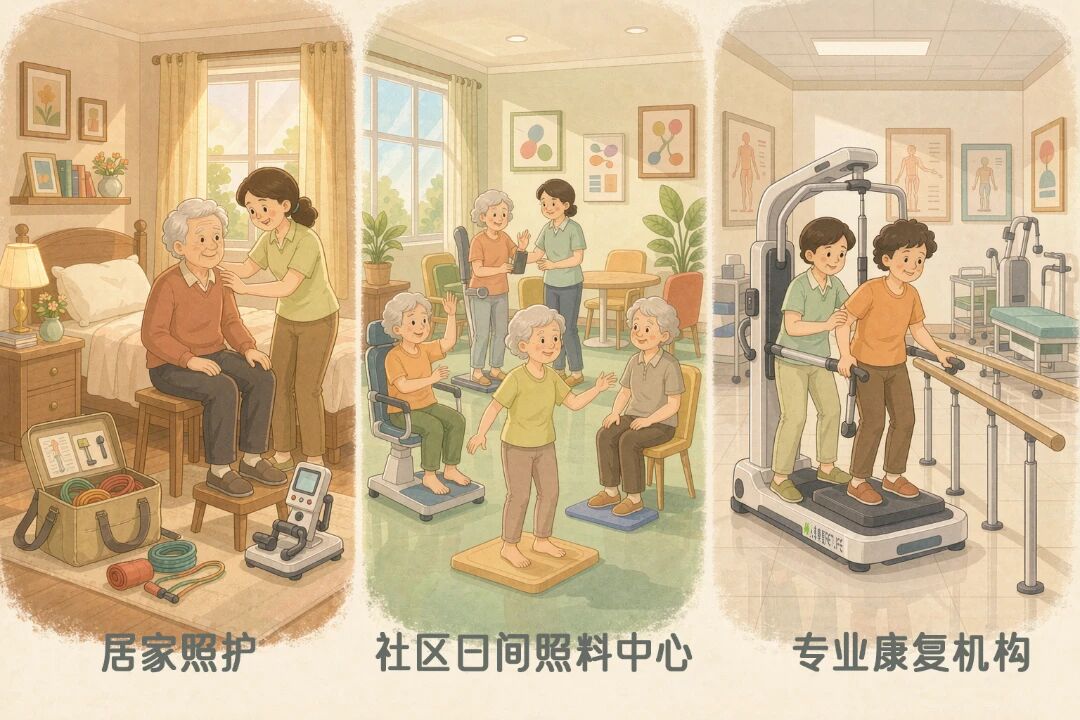
Matching Long-Term Care Insurance Scenarios: Three-Tier Equipment Allocation Logic
The typical profile of long-term care insurance recipients: severely disabled, long-term bedridden, with severely limited motor function. Corresponding to this profile, equipment can be configured in three tiers: Care Support → Function Maintenance → Rehabilitation Promotion :
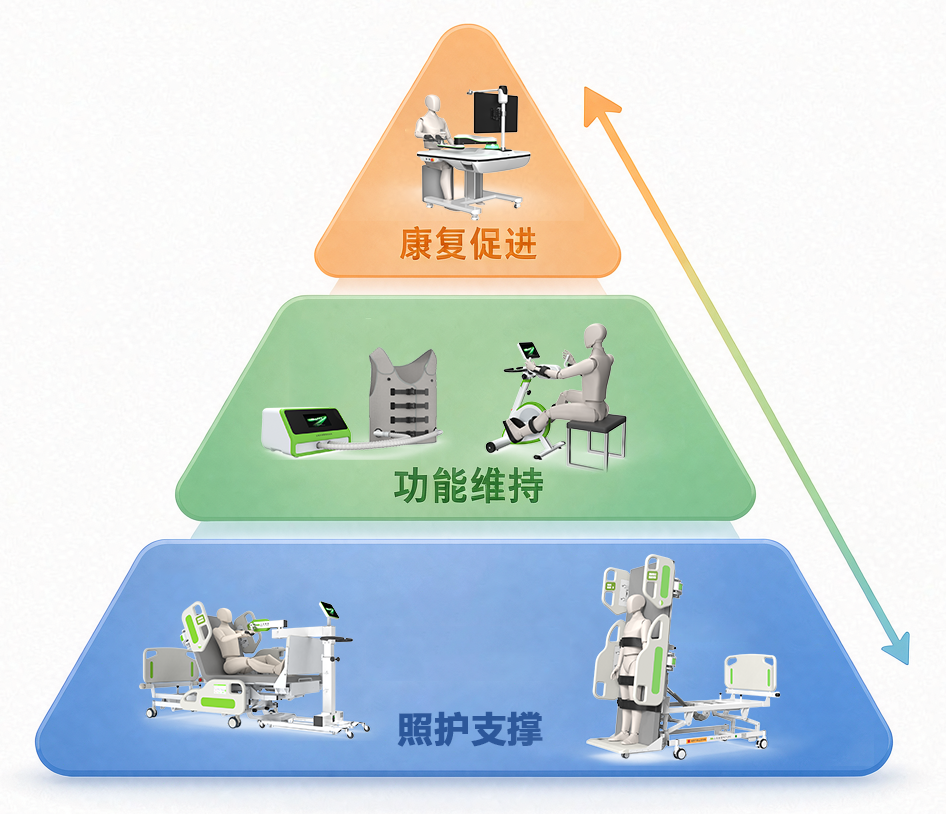
TierCore ObjectiveRepresentative Equipment & Model 03 Implementation Timeline & Time Window for Equipment Allocation Judging from the plans issued by each province, the implementation pace shows obvious gradient differences:
📍 Sichuan (Feb 2026): Resident contribution rate starts at 0.2%, covering both employees and residents from launch 📍 Hainan (H1 2026): Simultaneous coverage for employees and residents, one-step rollout 📍 Henan, Hebei, Liaoning (2026): "Employees first, residents gradually included" 📍 Hubei (Oct 2026): "Employees first, residents later", to be basically established by the end of 2028 This timeline illustrates three points:
① 2026–2027 is the critical window period|Each coordinated region is formulating implementation rules, assistive device catalogues and access standards. The time difference in provincial rollout equals the time difference for equipment allocation windows.
② Home and community care are policy priorities|Payment is tilted toward home and community care. Community day care centers and home visiting service providers will see the fastest business growth.
③ Assistive device catalogues will be the next competitive focus|Only products with proven clinical value, applicable scenarios and cost-effectiveness are eligible to enter future payment catalogues. Three Action Recommendations for Institutions First, audit equipment gaps against the service catalogue.Among the 36 long-term care insurance services, at least posture management, sputum care and motor function maintenance are directly related to rehabilitation equipment. Prioritize filling gaps in the sequence of "Care Support → Function Maintenance → Rehabilitation Promotion". Second, track updates of provincial implementation plans and assistive device catalogues.Assign dedicated staff to monitor notifications from local healthcare security bureaus: implement for provinces with issued plans, prepare contingency plans for provinces yet to release plans. Third, develop allocation plans differentiated by the three types of scenarios.Do not adopt one set of equipment for all scenarios: home care focuses on portable rental models, community care focuses on multi-user reusable models, and institutional care focuses on systematic graded care models.
"Policies set the direction, and equipment allocation determines implementation.
Renlai Rehabilitation takes ICF functional classification as the core of product R&D. It covers six major series: rehabilitation furniture, motor control, muscle function, mobility function, physical factor therapy and functional assessment, and provides customized equipment solutions for home, community and institutional long-term care insurance scenarios.
Care SupportSafe lying, turning and sitting up (posture management, transfer, feeding)Electric Nursing Bed RLRF306/307/304
Electric Standing Bed RLRF201/212
Electric Height-Adjustable PT Table RLRF112
Function MaintenancePrevent muscle atrophy and joint stiffness (complication prevention)Upper & Lower Limb Trainer RLMP402/401/404
Chest Physiotherapy & Sputum Clearance Device RLCP311
Swallowing Electrical Stimulation Device RLPY107
Rehabilitation PromotionPreserve improvement potential for eligible patients (functional improvement)
The value of rehabilitation equipment is no longer merely a 'treatment tool',
but a carrier for compliance with payment rules, a foundation for service delivery,
and a threshold for institutional qualification access."